Many older patients worry that their age makes them ineligible for joint replacement surgery. The reassuring truth is that there is no upper age limit for hip or knee replacement. Age alone should not prevent you from having surgery. What matters is your general health, medical fitness, and ability to tolerate anaesthesia. I have successfully performed hip and knee replacements on patients in their 90s who went on to have excellent functional outcomes.
The Evidence
I have a patient who was 96 years old when she had her second joint replacement. She had her first replacement at 94, and she did remarkably well after both surgeries. She remains active and functional well into her 90s. Age is clearly not the determining factor for surgical success.
There are no established upper age limits in orthopaedic surgery guidelines for joint replacement. The decision is individualised based on overall health, cardiopulmonary fitness, cognitive function, and ability to engage with post-operative rehabilitation.
"Age is just a number. What matters is your health, strength, and willingness to commit to recovery."
- Dr Chien-Wen LiewBeyond Chronological Age
In older patients, I focus on several specific health factors rather than age itself. First is anaesthetic fitness - can you safely tolerate general or regional anaesthesia? This is assessed through physical examination, blood tests, and often cardiopulmonary evaluation. Second is overall health - do you have significant uncontrolled medical conditions that would make surgery risky? Third is cognition and function - are you mentally able to understand the procedure and participate in rehabilitation?
Some 70-year-olds are medically complex and high-risk. Some 90-year-olds are remarkably fit and healthy. The assessment depends on the individual, not the birth certificate.
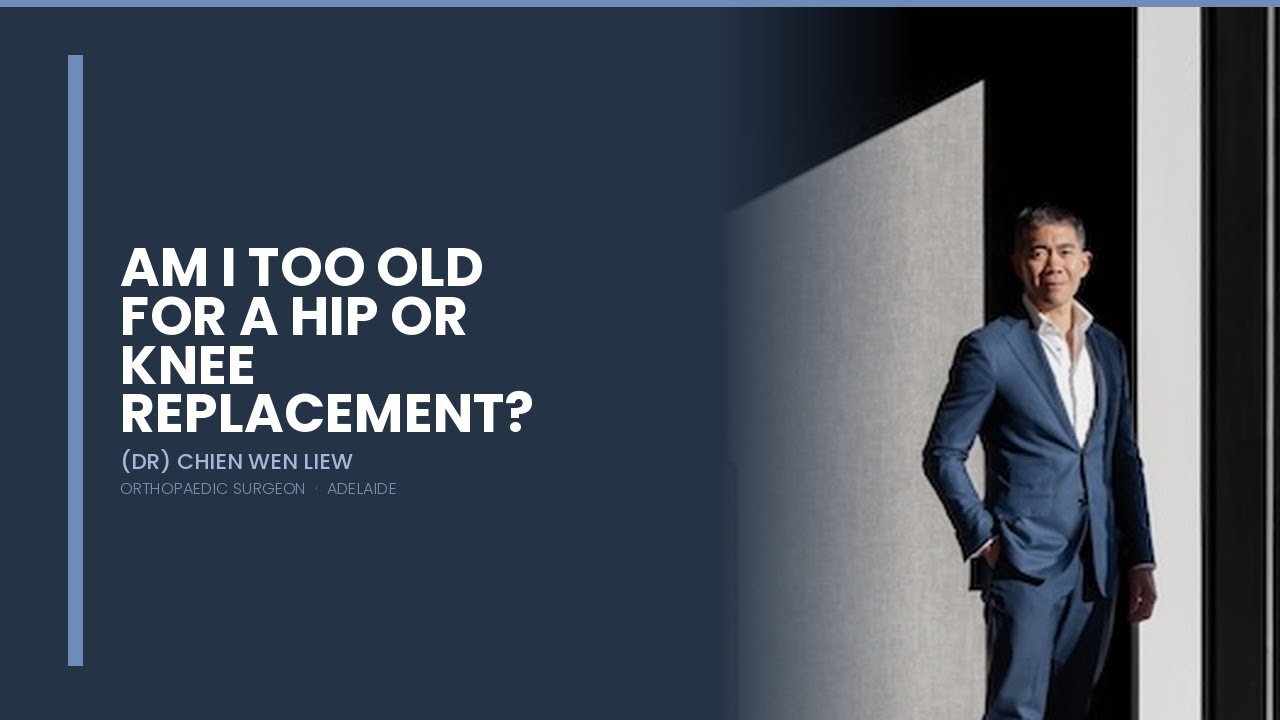
Dr Chien-Wen Liew explains why overall health and fitness, rather than age alone, guide whether a hip or knee replacement is suitable.
Read transcript
0:00 · Intro
Hi,, I'm Dr Chien-Wen Liew. Today, we're going to talk about a bit of more of a sensitive topic. But it's a question that I get a lot from a lot of my patients Am I too old for a hip or knee replacement?
0:23 · Criteria
I'm an orthopaedic surgeon from Adelaide, South Australia, focusing on hip and knee replacements. Whilst we do have a few criteria when determining the suitability of a patient for the hip and knee replacement, one of them is an age now. Whilst age can be a factor on our risk profile for the anaesthetic and surgery, it certainly isn't the main one. The first thing that we look for someone who might be suitable for a hip or knee replacement is number one, whether or not they need it now.
I've made a previous video about that, so you can check that out in the links below or look at our channel for that video. The next thing we look at are medical comorbidities. What that means are the medical conditions that you may or may not have that can impact upon the safe application of the anaesthetic and the surgery. Things, for example, like diabetes, elevated body mass index,
things like whether or not you're a smoker, or whether you drink a lot of alcohol. Those things are probably the four main risk factors for complications from the surgery.
1:28 · Risk Factors
We know that patients who smoke have a much increased risk of wound complications and infection. We know that uncontrolled diabetes have a large impact upon the risk of infection after a surgery, as well as wound healing complications. Things like blood thinners for other conditions, such as Warfarin for artificial heart valve or atrial fibrillation, may well increase the risk of wound complications from ongoing bleeding after the surgery.
Things like that certainly add to the risk profile, and we individualise and tailor our approaches to our patients after we know all about their medical history. That's why it is very important for us to get a summary from your general practitioner. And also for you to be aware of some of these medical conditions that you may have.
2:17 · Consultation
We will ask you a series of questions during the consultation and you may want to bring things up if you do not. Feel like. We've got all the information in your health summary now, as part of our decision about whether or not you're too old to have your hip or knee replacement is a discussion and decision about your functional limitations. As well as a frank discussion, really, about how you're coping and how long you may feel like you've got to live now, although we don't know how long we're going to live.
2:44 · Risk profile
And it's a bit of an absurd question in its own right. It does mean that we have to consider whether the risk profile of having a joint replacement matches with the amount of discomfort that you're in and the benefits of having that joint replacement on your rest of your life. Now, let's just say you were 90 years old and you're fit and healthy, and you are likely to live for another five to ten years.
Then if you said to me that you had a lot of trouble with walking, negotiating your shoes and socks? Getting changed in the morning, getting in and out of the car, and performing all of your normal activities without pain in the hip, then absolutely, we would consider you for a hip replacement.
3:31 · Conclusion
I would much rather consider a hip replacement for someone who was 90, who has no medical problems, has no major anaesthetic issues. Than to consider someone who might have uncontrolled diabetes, who was a smoker and was overweight. But only 60 years old. That 60 year old would have a much higher risk profile than our 90 year old. So it's certainly the case that, whilst age is a number, it's only a number and does not constitute the number one reason why
we would consider a hip or knee replacement, so when my patients asked me, Am I too old for a hip or knee replacement? I really discuss their medical comorbidities and whether or not they're in enough life discomfort and quality of life impairment to warrant one. I hope that answers the question and please feel free to ask in the comments below, otherwise I'll see you for the next video. Thanks for tuning in.
Transcript edited lightly for readability.
Can You Recover Well?
Recovery from hip and knee replacement in older patients is variable, but many do exceptionally well. Modern techniques, improved anaesthesia, and early mobilisation protocols have made recovery safer and faster than ever before. Most older patients are mobilising within hours of surgery and walking within days.
Rehabilitation may take longer in older patients, and progress may be slower, but improvement is achievable. Pain relief is often dramatic, and the ability to walk and function without pain is transformative at any age.
When Suitability Is Questioned
I have not refused surgery based on age alone. However, I have declined surgery in patients of all ages - including older patients - when significant medical issues made anaesthesia unsafe. Examples include uncontrolled cardiac arrhythmias, severe heart failure, or conditions that preclude safe anaesthesia.
The decision is always about medical safety and whether the patient is likely to benefit from surgery. If your health status puts you at unacceptable anaesthetic risk, then surgery may not be advisable - regardless of whether you're 60 or 90. But age itself is not the barrier.

Orthopaedic Surgeon, Adelaide
Frequently Asked Questions
Assess Your Medical Fitness
A guide to understanding anaesthetic assessment and health evaluation for older patients.