Not everyone with hip or knee arthritis needs surgery immediately. In many cases, a structured non-operative programme can delay the need for joint replacement by months or even years - and meaningfully improve quality of life in the meantime. Every conservative option should be explored and optimised before surgery is considered.
Exercise and Physiotherapy
Exercise is the single most important non-operative intervention for hip and knee arthritis. Strong muscles around the joint reduce load on the articular surfaces, slow the progression of arthritis, and reduce pain - often dramatically. A supervised physiotherapy programme tailored to your arthritis pattern is the starting point.
The exercise does not need to be aggressive or painful. Low-impact options - cycling, swimming, hydrotherapy, walking, and resistance training - are all effective and well-tolerated. The key is consistency over time.
Weight Management, Analgesia & Injections
Weight management - every kilogram of body weight lost reduces knee joint load by approximately 4 kilograms during walking. Even small reductions (5–10kg) can make a significant difference to symptoms. Diet and low-impact exercise together are the most effective combination.
Analgesia - simple pain relief used strategically around activity (not continuously) can allow patients to remain more active. Paracetamol, NSAIDs (if tolerated and appropriate), and topical agents all have a role.
Joint injections - corticosteroid injections provide meaningful short-term relief in appropriate patients. Hyaluronic acid (viscosupplementation) injections provide a longer-duration effect in some patients. These are not cures, but they can buy meaningful time.
Supplements - Glucosamine Sulphate 1000mg and Fish Oil have shown symptomatic benefit in some studies. They are safe, inexpensive, and worth trialling for 3 months.
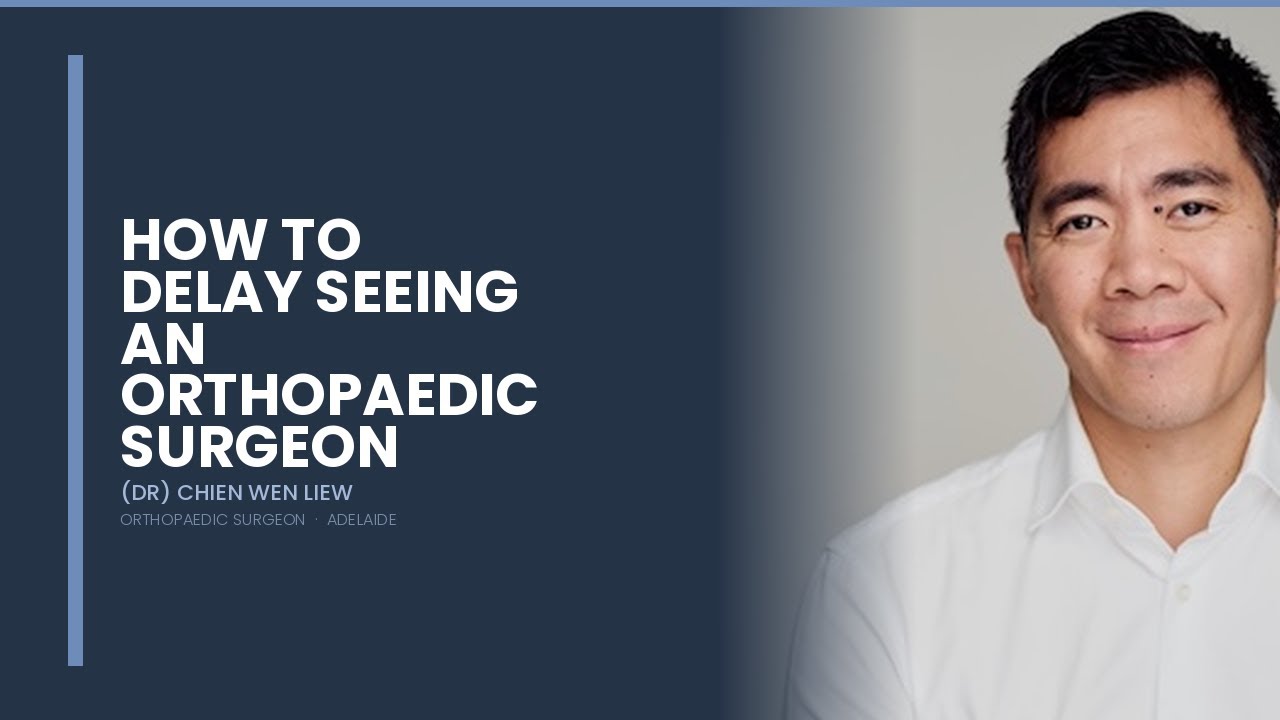
Dr Chien-Wen Liew outlines non-surgical options for hip and knee arthritis, including weight management, exercise, supplements, pain relief and injections.
Read transcript
0:00 · Introduction
Hi, I'm Dr Chien-Wen Liew. I'm an orthopaedic surgeon who specialises in hip and knee replacements only. I'm from Adelaide, South Australia and work in a fantastic group called Orthopaedics 360. Today, we're going to talk a little bit about the non-operative management of hip and knee osteoarthritis. Whilst there are other types and reasons why you might need to go on to have a hip and knee replacement, today we're going to go over just one of the more common ones, which is osteoarthritis of the joint.
0:50 · Management of Osteoarthritis
Now, osteoarthritis is something which really just means degenerative change to a joint, causing inflammation around the joint, and certainly can translate to restriction in mobility, restriction in range of movement, and constant pain. Now, the non-operative measures are fantastic things to try to delay the surgery. But, if you do have advanced osteoarthritis and it's getting worse and worse, there is nothing that will stop the development of worsening symptoms, but there are certainly things that can make it more tolerable whilst you wait for your hip or knee replacement.
1:30 · General ways to avoid seeing an orthopaedic surgeon
Now, to start with, we look at the general things that can help you. And they are things that you can do without any medication, without anything that except a change in lifestyle. Now, if you're finding certain things like putting on shoes and socks difficult, getting in and out of the car difficult with your hip arthritis, or you're finding it difficult to negotiate uneven ground, or you're finding it difficult to position the knee for certain locations in the car when you're driving.
There are little aids that you can use to help with that. There are things you can buy to help you place your shoes and socks on. There are things like walking sticks, walking frames if you need to for balance or mobility and stability. Now, all of those things can certainly be tried and they can be guided to you by your local physiotherapist or general practitioner. In addition to this, we can look at other personal aspects like weight loss.
2:23 · Weight loss as a factor
We know that every kilogram that you lose has a significant effect on the amount of discomfort that you may feel through a hip or knee joint. And certainly an arthritic hip or knee joint will benefit greatly for a reduction in excess weight. Now, if you're already of great weight, fantastic. We've got other things to do. But if you are overweight or significantly overweight, either addressing that with your diet as mobility can and exercise can sometimes be difficult is the first step.
Now, we do have a lot of guidance from a lot of our weight loss doctors and dieticians which can help. And if you need a recommendation, we can certainly give you something of that nature. But if you do feel like you can do it on your own, dietary changes will make the biggest improvement.
3:10 · Physiotherapy
After that, we look at physiotherapy. Now, in general, physiotherapy is extremely useful for hip and knee osteoarthritis. We find that knees especially gain a lot from physiotherapy directed activities. By strengthening the knee and surrounding muscles, you find that a knee can significantly reduce the pain associated with osteoarthritis. That's because a knee joint is inherently unstable. It's really just two platforms of bone held together by ligaments and muscles around it.
And if we removed all of those, it just moves around quite a lot and causes pain from the micro instability. For a hip joint, however, a hip is very stable. And it actually is a ball and socket which is kept in there quite well without a huge amount of muscle tension to hold it all together. And that means that physiotherapy, whilst it can be very useful for some patients with hip arthritis, is not as critical as those patients with knee arthritis.
Physiotherapy directed exercises are generally aimed at maintaining muscle stability around a joint, maintaining as much flexibility as you can in the constraints of how much bony disfunction there is. And if you have large bone spurs around a hip or a knee, you will find that the range of movement will be significantly restricted by those.
4:29 · Glucosamine and Fish Oil
As far as the mobility of a joint goes, that can be in part due to the swelling of the joint. And sometimes we can look at pharmacological agents to help us with that. Now, things like glucosamine and fish oil have been relatively well studied. Glucosamine is a glucosamine sulfate, and fish oil should generally be taken as a liquid. Now, because those two have been mostly studied, they are the ones we recommend as a first line attempt at reducing the discomfort from the underlying arthritis.
Their function is unfortunately not to replace the cartilage around the joint, but is actually to act as a natural anti-inflammatory. And they have actually been shown to do that reasonably well in approximately 2/3 of patients. That means that if you are one of those people who notice a benefit from glucosamine or fish oil may find a short trial worthwhile; evidence is mixed, so check with your GP.
5:24 · How to take Glucosamine and Fish oil
Now, our recommended way to take this is if you take glucosamine and fish oil for 1 month every single day, and then you stop at the end of 1 month, and you notice no difference after you've stopped it, then you may unfortunately be one of those 1/3 of patients where it makes absolutely no difference. We like to try things like supplements in a very scientific way so that we're not taking lots of different supplements not knowing which ones work and which ones don't.
5:51 · Alternative supplements to try
The next potential medication that you can try are things like turmeric or curcumin, which is the active ingredients in turmeric. Now, turmeric and curcumin have been shown to also be as a second line improvement in anti-inflammatory properties. And you can take those in the same way that I described with the glucosamine and fish oil. Now, evidence for turmeric and curcumin is limited, but some patients report that when they start taking those supplements, one or the other, it certainly helps them with their underlying discomfort.
On top of those more natural supplementations, we can look at other things like just straight normal Panadol. Now, Panadol is a tablet that you all would be familiar with. Its other name is paracetamol. Paracetamol is something that can be taken multiple times a day as directed by your local Dr, and can be very safe for the long term.
6:49 · Panadol vs Panadol Osteo
Panadol Osteo has been marketed as a medication that can help you specifically for osteoarthritis. It is a medication almost exactly the same as Panadol, except that it is of a different dose. Now, because it is a different dose, you don't need to take it quite as frequently as standard Panadol. And that means that it potentially could be easier for you to take over a longer period of time as most patients are advised to take it up to three times a day or with each meal.
On top of the standard Panadol are anti-inflammatories. Things like Nurofen, Voltaren can be taken. They are over-the-counter medications and can be safe in most individuals.
7:34 · How to take anti-inflammatories
We usually recommend that people take it in a regime of a few days on and a few days off. The reason for this is to allow the stomach lining to regenerate between doses to allow you not to have that higher risk of any sort of inflammation of the stomach or potentially a stomach ulcer. If you've already had one of those things, it is preferable that you do not try to take Nurofen or Voltaren or one of the anti-inflammatories or that you speak to your local Dr about other medications that might protect you from the side effects of those medications.
Preferably, they should only be used for the short term and should not constitute a long-term part of your of your arthritis management. Other than those medications, we certainly do not want to venture into the stronger medications. The stronger medications include things like Panadeine Forte, Tramadol, Palexia, and Endone. They're very strong medications. The downside is that you probably shouldn't be driving on those medications and certainly should not be operating heavy machinery or making very important decisions.
They can be sedating and they can alter the way you think as many of our patients may know if they have taken it for the first time. I would recommend that before starting any of those medications, that you attempt all of the other modalities such as physiotherapy, weight loss, and simple supplements or analgesia before you try to get into any of those things. When the time comes to consider surgery, those things can be used after the operation for a short duration, but really should not be taken unless absolutely necessary for very short periods of time.
9:16 · Untested modalities for management
Other potential modalities for managing osteoarthritis have really not been that well tested. We look at things in the literature like injections with steroid, injections with platelet-rich plasma. We look at things like stem cells, and although all of those things can give you short-term duration of action or they can help you with some of the symptoms for a short amount of time. In general, they have proven to be less effective than they originally were anticipated.
So, they do not really constitute part of our treatment of non-operative measures, unless there are circumstances which warrant their use. To get more of an idea about the non-operative measures that you may seek, please don't hesitate to reach out to your local Dr or physiotherapist. We generally find that when you've exhausted all of those non-operative measures and your quality of life continues to be impaired by your hip or knee osteoarthritis, that is the time to start considering a hip or knee replacement.
10:14 · When you should probably see an Orthopaedic Surgeon
If you haven't tried all of those things and you're still unsure about whether or not you should have a hip or knee replacement, it's critical to look back at the trajectory. Have you been exactly the same for the last 2 years, or have things been getting worse and worse over time? If things have been getting worse and worse and every month is worse than the last and you're not achieving what you want to and the non-operative modalities aren't working, then we know that you're almost at that stage where a hip or knee replacement should be considered.
But like with anything, we try to avoid it until the moment where you feel like you really have to have it done. Please don't hesitate to reach out and let me know in the comments below what you feel and we can certainly aim to reply to many of those, but in the meantime, like and subscribe to this channel and follow us on Facebook and I look forward to keeping you updated on all the different things hip and knee replacement. Thanks for watching.
Transcript edited lightly for readability.
Frequently Asked Questions
Download Patient Summary
A one-page branded summary of this topic - QR code links to the video or full article.