We have the pleasure of treating patients from all over Australia - and we tailor our peri-operative management around convenience. It is more difficult to attend our clinic for appointments when you live regionally, especially for routine reviews. Whilst we will always be available to see you in our usual schedule, sometimes it is more convenient to make changes to suit your travel to and from Adelaide.
Managing Your Care From Afar
We have systems in place to ensure you are well supported throughout your journey. Telehealth consultations are available for pre-operative review, post-operative check-ins, and most follow-up appointments that do not require a physical examination. Our team is available by phone and email throughout your recovery.
Your wound dressing should remain on until at least 2–3 weeks post-op, and then be replaced with a simple Hypafix dressing that stays on for a few days to protect the wound after dressing removal. Try to keep the surgical wound dressing dry - whilst it is waterproof, it needs to be kept relatively dry so it lasts the 2–3 weeks. If you get splashes on it, do not worry - it can handle this.
Preparing to Fly Home
You can fly directly home after discharge - typically 2–4 nights post-operatively. Dr Liew may recommend staying an extra night if you require more independence before a long flight. Many regional patients also choose to stay in Adelaide for a few days or for their 2-week post-op visit before travelling home.
Boarding a flight will most likely require you to use a walking stick. A walking frame is usually not required, but if you used one prior to surgery, the same process applies on the way home. Airlines may have variable requirements if they notice you have had recent surgery - forms for Qantas, Virgin Australia, and REX are linked here.
Medications - you will have some controlled substances when you travel back, such as Endone or Palexia. Carry these in their original dispensed packaging and do not carry more than prescribed. This avoids any issues at customs.
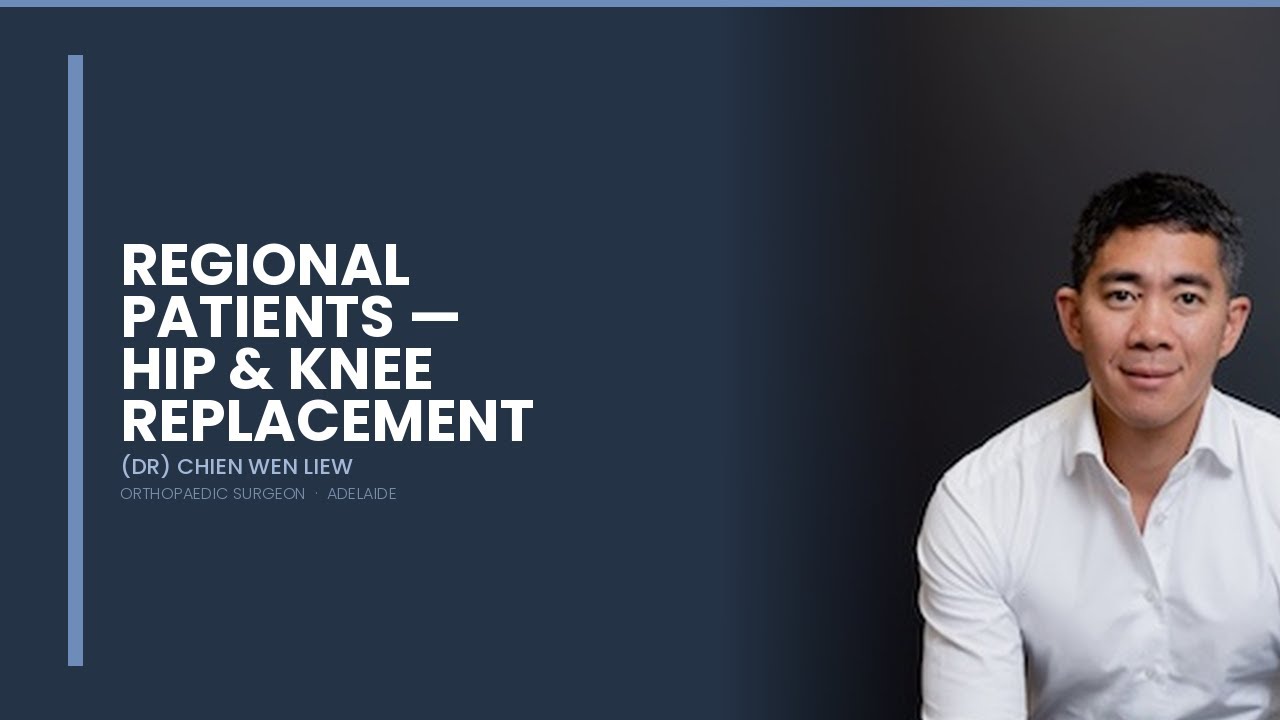
Dr Chien-Wen Liew explains how surgery and follow-up are arranged for patients travelling to Adelaide from regional South Australia and the Northern Territory.
Read transcript
0:00 · Introduction
Hi, my name is Dr Chien-Wen Liew, and today I'd just like to go over performing surgery for a hip or knee replacement. For my patients that are a little bit further away now, we have quite a lot of patients come in from quite far away, and in Adelaide, far away for us can mean an hour, hour and a half. But it can also mean coming in from Darwin, Alice Springs, Victoria, Mildura, Port Lincoln, Goolwa, Victor Harbor, Robe, all of those locations that are a little bit further away from us.
0:39 · The Long trip to see me
Firstly, I'd like to say that I am grateful for you making the long trip down to see us. It is our pleasure to look after patients from all over Australia. And we've put this video together just to give you some idea of the expectations that we have after surgery or your expectations, but also to give you a little bit of an update as to the overall protocol,
because things do change to allow us to reduce the number of visits that you have back to Adelaide. But also give you the confidence to check in with me on a regular basis and have that communication that we would normally have.
1:11 · Surgical expectations
Now, the first thing to say is that your surgical expectations should be exactly the same as if you live just around the corner. We perform exactly the same procedure, no matter where you're from, but it does mean that we do a few things differently. After the surgery, now, with a hip and knee replacement with me, most of my patients are performed under a spinal anaesthetic. Your stay in hospital is roughly about 2 to 3 nights.
1:34 · Goals of immediate post op period
We keep you there until you're walking safely, your pain's under control and your feeling well enough to go home and you're independent. We will not let you leave hospital if you don't feel like you can look after yourself, because we do not need you to leave hospital and have someone nurse for you. For the first couple of weeks, you should be able to look after yourself. When you leave hospital,
1:54 · What to bring to hospital
the first thing to discuss is really what you should bring into the hospital when you are a little bit further away from your own creature comforts. The number one thing that I would recommend is to make sure that you have a form of communication. Now, you may be coming down with one of your loved ones, but you may also be coming down alone. Which means having a phone and a phone charger, or even your device that allows you to email or FaceTime.
Or contact your loved ones is a critical support part of this journey. It is something that I would recommend you, ensuring that you have so that you can contact people immediately after the surgery, let them know how you're going. Bringing your own clothes, your own pyjamas and amenities is also something that I find. The little creature comforts of life that the hospital may not provide for you, it is nice to get back into your own pyjamas outside of the hospital.
Gown as quickly as you can after the surgery, and having your own comfortable clothing is important as well. Now, when we perform our hip replacements, especially, it is important for you to bring underwear that is quite loosely fitting and nothing that is too tight around that hip region. As we do not want your clothing and elastic parts of the clothing to rub against the wound. It's nice for you to have some shorts to wear for a knee replacement, so that we can easily fit our ice machine to your knee after the surgery.
So bringing those things as well as some nice, stable shoes will be of critical importance to you. As it is very difficult for someone to pop home if you live very far away, to grab the things that you need. Packing a few days before surgery and revisiting it the day before surgery can sometimes be something that is easier to manage, rather than trying to do it. Either on the day of surgery or just the night before.
3:39 · Period in hospital
Your stay in hospital will roughly be the same as our local patients. However, we do think that, in some cases, will keep you for an extra night, or at least an extra amount of time. To make sure that you're more confident when you go home, especially if you are flying back home, if you're flying back home often.
3:54 · Flying back home after surgery
You'll need some forms filled out, so make sure you have a chat to our nurses or in-house doctors to make sure that those forms are completed. Because the airlines will not allow you to board without some kind of documentation from a Dr. To say that you're able to fly, especially if you're going from hospital to airport directly. Now you are able to fly home, so please don't feel like you're not allowed to fly.
The risks of flying those 2 to 3 hour flights is certainly not something that you need to be too worried about. We already have you on blood thinness. You'll have some tight stockings to wear, most likely on the calves, and if you're up and walking, that's the biggest thing. That will prevent DVT, which is deep venus thrombosis, or blood clots, and pulmonary embolisms, which are the ones that go to the lungs.
So those are the risk factors for long flights, but really, for short flights, they are of less of a concern. And certainly they should be able to be achieved with a normal flight home. Which actually with compared to going in a car now if you're in a car for a long period of time.
4:56 · Driving home long distances
For example, if you're travelling 8 hours to get back to Port Lincoln, for example, that is probably something that we like to break up into segments. Trying to drive 1 to 2 hours at the most, with a short break where you can get out of the car. Walk around, stretch the legs and allow yourself to have that blood flowing through the body. And a consistent period of your drive will certainly make things a lot more convenient, but a lot more safe for you as well.
You will not find that you'll have that same really painful stiffness that you will have. If you sit in a car for 8 hours at a time and get out for the first time after, that is certainly not recommended. I would also recommend, if you're going on a long car drive home to bring some ice packs or pack them into the car because that will allow you to cycle through those ice packs.
Just to keep yourself comfortable, pushing the chair back or sitting on the back seat are the other options as well. They can all be achieved, and they're certainly not something that you need to stay away from.
5:56 · Staying in Adelaide after surgery
But if you did wish to stay in Adelaide, then I will always recommend that you stay in there until you see me for your first 2-week appointment. Now, not all my patients can do that, and I certainly think that. If you're looking to go home directly from hospital, we arrange a convenient way for us to do your wound dressing.
6:15 · 2 week wound check appointment
Our two-week dressing is something that happens quite quickly. We actually remove the dressing from your hip or knee, we check that everything looks okay. We wipe over it with a little bit of either alcohol or Betadine if required, and then we place a very small strip of Hypafix dressing. Now, if you are from regional Australia, where it's harder for you to get in to see your Dr and you're not travelling back to see me.
Then I will actually provide you with a dressing pack, so please advise me before the surgery if you're planning on doing the dressing yourself. And I'll give you a little pack. Which includes just a little bit of cleanup. As well as a Hypafix dressing to place on top, and that Hypafix dressing is meant to last for a week or two. After the surgery, it can get wet after the operation.
But remember, we have the initial dressing that stays on for 2 to 3 weeks, we have the Hypafix dressing that stays on for 1 to 2 weeks. Do not enter bars, swimming pools, ocean for 4 weeks after the surgery. So that's our time period to allow the wound to fully seal, to reduce the risks of any sort of infections getting into the wound. As always, at that 2-week mark.
If you are concerned, then please contact me. I would also like all my regional patients to SMS me directly with their photo of their wound. If you're doing that yourself, just so I can take a look and ensure that it looks good. So, removing the dressing, taking a photo and then cleaning it up and placing the new dressing on is all that's required for that first 2-week mark.
Any questions or queries that you have at that time, you should direct them straight to me. You'll have my direct line for you to message me after the surgery at all times. So if there's any concerns, please don't wait until then to bring them up with me. I' like to know everything as it occurs if you are concerned along the way. For all of you who live in the regional parts of Australia.
7:58 · Getting help when you live far away
It is difficult for you to see a Dr and harder for you to pop in and see me if something's going on. So you will have, like I said before, that, direct line to me. But also if you need more analgesia, please check your email, which you'll have a link in the email that I send you. About 3 or 4 days after the surgery, which allows you to request more pain medication as you need.
I'll always correspond with you and send you back an escript. That escript comes through as a text message to your phone. That you can bring to the pharmacy and obtain those medications at any time. If there's any concerns with this, we can probably email that to you as well. Depending on what's more convenient for you to achieve, usually the SMSs are the easiest ones for us to send you. Our usual post operative check-up after the 2e mark is a 3month check.
8:44 · Routine check up at 3 months
Now, during this period of time, if there are any concerns, then you are to contact me directly. But at 3 months is usually either a good time for you to reassess how you've been going. With a hip replacement, I expect you to be roughly 80 to 90% through the recovery, and for a knee replacement, 70 to 80% through recovery. You may be under the care of a local physiotherapist or Dr.
And if there's any concerns from them, I'd like to know about it before them. At 3 months, you'll receive another email from me indicating some of the expectations in more detail about what you would be experiencing at that time. At 3 months. If you feel like you fall inside of that email, that's fantastic, but if you don't, then please do not hesitate to contact me at any time.
We'll go through that over the phone to determine if there's any further scans necessary. The 3-month mark is usually the first formal x-ray that we get of your hip or knee replacement as well. And that is the time that I'll send you a copy of that x-ray at your convenience, just so you can see what we've put in there. That's usually our first indication of how the implant looks during the surgery, as you know, we already take some images of your hip and knee at the time of surgery.
I can provide those to you as you need, but you may have seen them in your video or postoperatively anyway. So, if you are from a more regional or remote area of Australia, please don't hesitate to contact me at any time after the surgery. It should be somewhere where there's quite a lot of communication, as much as you require, just so that you're comfortable with how you're going. Because I know that it is harder for you to pop in and see me now.
10:20 · Seeing me out of schedule
If you're in Adelaide for any other reason around that 3-month mark and you'd like to pop in to see me in the rooms. It does not have to be right on the 3-month mark that we check in, it could be 2 and 1/2 months, it could be 5 months. Pop in to see me at your convenience when we have a spot that lines up with when you're in Adelaide.
And we'll make sure that we adjust our time frames to suit your personal schedule as well. Any issues or queries or questions, please let me know. But I hope this helps to give you a little bit of confidence into the post-operative period after your hip or knee replacement. Especially if you live from out of town. Have a lovely day and I'll catch you for the next video.
Transcript edited lightly for readability.
Frequently Asked Questions
Download Patient Summary
A one-page branded summary of this topic - QR code links to the video or full article.