Weight-loss injections and osteoporosis injections are now common in the same age group as hip and knee replacement. This article sets out what the published studies show about muscle, bone and uncemented implants. It is general information. It is not a plan for your medicines. Do not start, stop or change a prescription without the doctor who prescribes it, and your GP.
Semaglutide and tirzepatide: weight, muscle and bone
Semaglutide is the active ingredient in Ozempic and Wegovy. Tirzepatide is the active ingredient in Mounjaro. Semaglutide acts on the GLP-1 receptor. Tirzepatide acts on GLP-1 and GIP receptors. Both can produce large weight loss. Weight loss is mostly fat, but lean tissue falls as well.
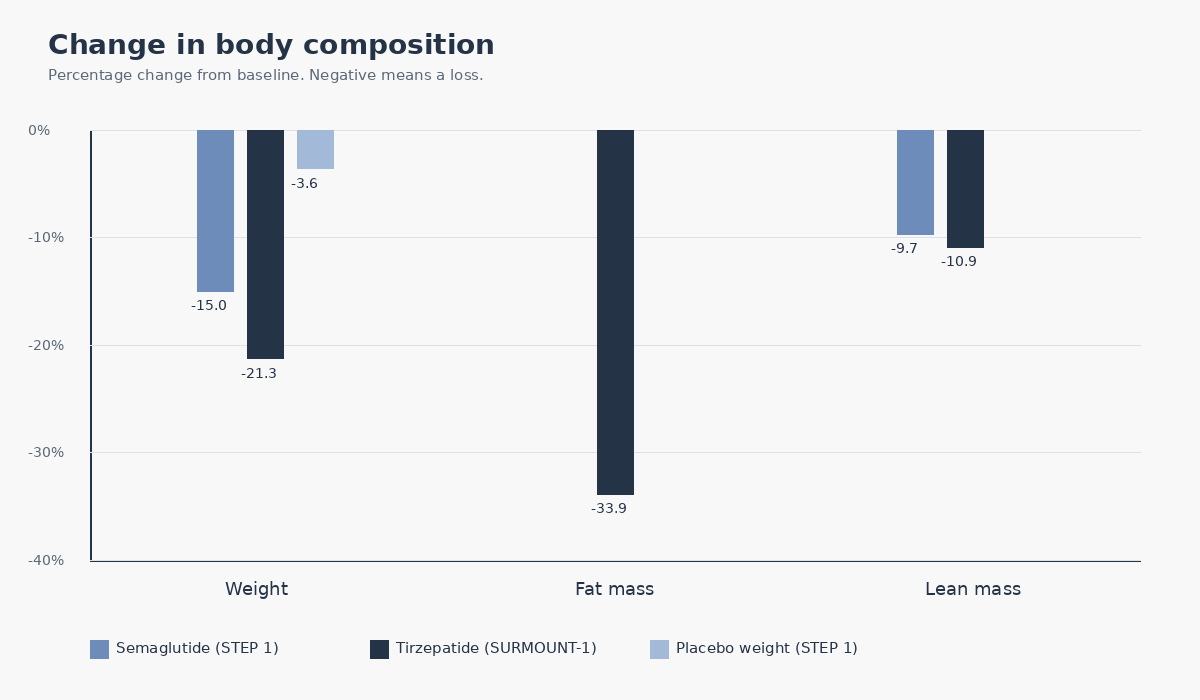
A DXA substudy of the STEP 1 trial (2021) compared semaglutide 2.4 mg with placebo. Body weight fell 15.0% with semaglutide and 3.6% with placebo. Lean mass fell 9.7% with semaglutide. The share of the body that was lean rose by about 3 percentage points, because fat fell by more than lean tissue.
A DXA substudy of SURMOUNT-1 (Diabetes, Obesity and Metabolism, 2025) looked at tirzepatide. Weight fell 21.3%, fat mass 33.9% and lean mass 10.9%. About three-quarters of the weight lost was fat and about one-quarter was lean mass.
Pooled analyses point the same way, with wide uncertainty. A meta-analysis estimated that about 30% of weight lost on these medicines is lean mass, and that lean mass was 1.9 kg lower than with placebo. A 2026 review in BMC Endocrine Disorders reported lean mass about 3.43 kg lower with semaglutide and 4.40 kg lower with tirzepatide, and graded the certainty as very low. Lean mass on a DXA scan is not the same thing as muscle strength or how the muscle works.
Bone density
Effects on bone are mixed, and they depend on whether people also exercise. An eClinicalMedicine trial in 2024 of semaglutide in adults at higher fracture risk found slightly lower hip and spine bone mineral density than placebo. A JAMA Network Open trial in 2024 of liraglutide, an older GLP-1 medicine, found that liraglutide alone lowered hip and spine bone density, while liraglutide plus exercise preserved bone density even though that group lost the most weight. A 2026 meta-analysis in Drugs, covering about 1.25 million people, found no clear effect on bone density or fractures once the analyses were adjusted. That is reassuring at population level. It does not mean an individual hip or spine is unchanged.
Keeping muscle and bone while the weight falls
A 2025 joint advisory in the American Journal of Clinical Nutrition is practical. It suggests resistance training at least three times a week, plus about 150 minutes a week of moderate aerobic activity, and protein intake of 1.2 to 1.6 grams per kilogram of body weight per day during weight loss. Protein on its own is unlikely to be enough. The training is the other half. Diet and protein before surgery are also covered in nutrition and joint replacements.
If you are losing weight before a hip replacement or knee replacement, the useful aim is not only a lower number on the scale. It is to arrive at surgery with as much strength and bone as you can keep. How you prepare more broadly is set out in patient factors before surgery.
Bisphosphonates, Prolia and uncemented implants
Denosumab is sold as Prolia. Bisphosphonates include tablets such as alendronate and the intravenous medicine zoledronate. They are prescribed for osteoporosis. Around an uncemented hip or knee replacement — also called a cementless implant — the new implant is meant to lock to living bone. That process is osseointegration. Researchers have asked whether these medicines change the bone next to the implant, or how much the implant moves, in the early years.

What randomised trials found
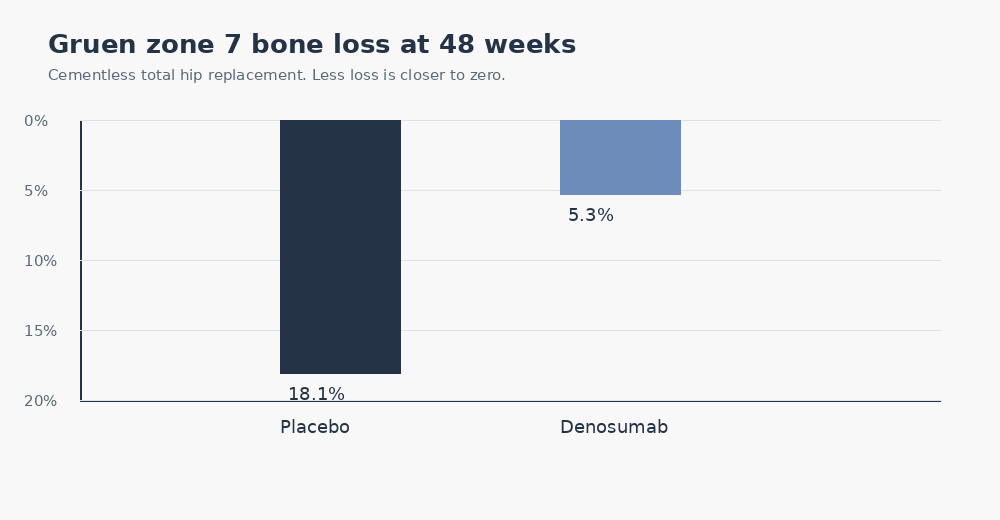
A 2019 randomised trial in JBMR Plus enrolled 65 women having a cementless total hip replacement. Denosumab was started one month before surgery. At 48 weeks, bone loss in Gruen zone 7 — a patch of bone at the top of the thigh bone next to the stem — was 5.3% with denosumab and 18.1% with placebo. Early movement of the stem did not differ, and every stem had osseointegrated. The bone-density benefit faded after the medicine was stopped. A 2025 follow-up in Acta Orthopaedica, at about 5.6 years, found no remaining difference in bone density.
At the knee, a 2017 Acta Orthopaedica trial found that denosumab reduced 12-month implant migration by about a third: 0.24 mm compared with 0.36 mm. A 2025 Bone & Joint Journal trial of 82 cementless total knee replacements found that local zoledronate and denosumab each reduced one-year migration by about 0.4 mm. At five years, tibial subsidence was 0.50 mm less with zoledronate and 0.30 mm less with denosumab than in the comparison group. These are small distances. They are measured on radiographs. They are not a promise about how a knee feels.
Not every medicine, and not every trial, shows a difference. A 2010 Acta Orthopaedica trial of oral alendronate found no difference in migration of uncemented knees.
Meta-analyses pull trials together. Papers in the Journal of Orthopaedic Surgery and Research in 2015 and 2018, and a 2024 network meta-analysis of 22 randomised trials in the Journal of Orthopaedic Science, describe less stress-shielding bone loss with these medicines. Differences in function were small. The trials do not have revision surgery as a measured result.
What registries and cohorts show, and what they cannot show
Larger observational studies look at revision, which is a further operation. They can only show association. People who are prescribed a bone medicine differ from people who are not, in age, bone density and other illnesses.
- A 2011 BMJ study reported a five-year revision rate of 0.93% in people who had used bisphosphonates and 1.96% in those who had not.
- A Danish cohort in Arthritis & Rheumatology, 2014, reported about 59% lower revision when bisphosphonates were started after surgery. The same pattern was not seen when they were started only before surgery.
- A 2026 Osteoporosis International registry analysis of knees found a higher revision rate with denosumab (6.8%) than with alendronate (1.9%). Hip revision rates were similar between those groups.
Taken together, the randomised evidence that bone medicines can slow early bone loss, or slightly reduce early movement of some uncemented implants, is encouraging. It is not definitive. It does not say that everyone having a hip or knee replacement should start one of these drugs, and it does not say that an implant will last longer.
Do not stop Prolia without a plan
There is a separate safety point, and it matters more than the implant studies. A 2021 European Calcified Tissue Society position statement in the Journal of Clinical Endocrinology & Metabolism advises against stopping denosumab without moving to another treatment, often zoledronate. Stopping denosumab on its own is linked with a rebound rise in bone breakdown and with vertebral fractures. Surgery is not a reason to skip a dose unless the prescribing doctor has made a plan.
Long-term bisphosphonate use has its own rare risk. A 2019 Bone & Joint Journal review links long-term use with atypical fractures around a hip replacement. That is uncommon. It is one reason these medicines are reviewed rather than left running without a check.
There is no formal society guideline on the exact timing of denosumab or bisphosphonates around hip or knee replacement. Timing is a decision for the doctor who prescribes the bone medicine, with your surgeon and your GP. Bring the name of the medicine, and the date of the last dose, to the pre-operative visit. Preparation more generally is outlined in patient factors before surgery.
Frequently asked questions

Orthopaedic surgeon, Adelaide